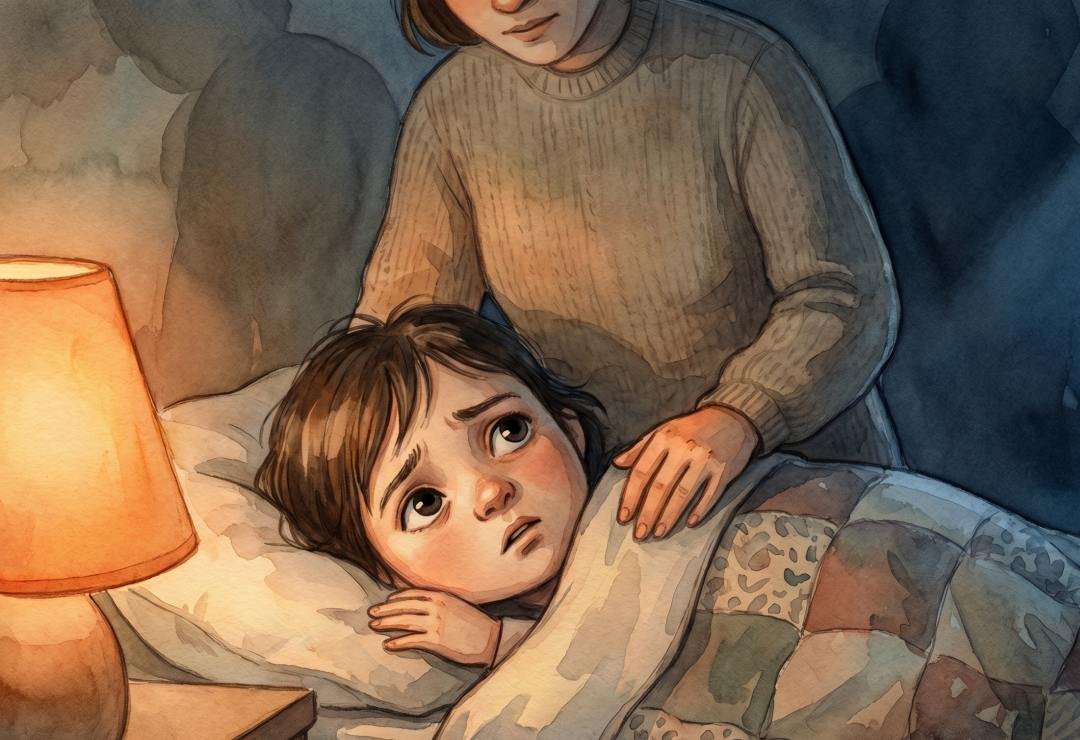
Many children feel anxious at night. The bedroom is quiet, there are no distractions, and the thoughts that were kept at bay during the day come back. For some children, this happens occasionally. For others, it is a pattern — difficulty falling asleep, fear of the dark, worry about the next day, separation from parents.
Bedtime stories have always been part of how families manage this moment. What research now shows is that stories do more than fill the silence. They actively reduce anxiety — and there are specific reasons why.
What Anxiety Looks Like at Bedtime
Anxiety in children does not always look like what adults expect. It is not always crying or panic. More often, it shows up as:
- Repeated requests for water, another hug, one more story
- Complaints about stomach aches or headaches that disappear in the morning
- Difficulty staying in bed, even when clearly tired
- Fear of the dark, monsters, or being alone
- Worry about school, friends, or things that happened during the day
These are normal responses to a nervous system that has not yet learned to switch off. The brain at night, without stimulation, processes the day's unresolved emotions. For children, who have fewer tools to manage this than adults, it can feel overwhelming.
What Stories Do to the Anxious Brain
When a child listens to a story, something measurable happens in the body. A study published in the Proceedings of the National Academy of Sciences found that storytelling increases oxytocin — a hormone linked to feelings of safety and connection — and reduces cortisol, the hormone the body releases under stress. The effect was twice as strong as other forms of entertainment tested in the same study.
In plain terms: listening to a story makes the body feel safer. The stress response quiets down. This is not a metaphor — it is a hormonal shift.
A separate randomized controlled trial published in BMC Complementary Medicine and Therapies tested storytelling against other interventions in children aged 3 to 8 and found that storytelling significantly reduced anxiety scores. Among all the interventions tested, storytelling had the greatest effect on reducing anxiety in younger children.
Why Stories Work Better Than Reassurance
Many parents try to manage bedtime anxiety through reassurance — "there are no monsters", "you are safe", "everything is fine". This is a natural response, but it has a limitation: it asks the child to reason their way out of a feeling. And feelings, especially in children, do not respond well to logic.
Stories work differently. They do not argue with the fear. They give it a shape — a character, a problem, a resolution — and let the child experience the resolution from the inside.
Research published in Humanities and Social Sciences Communications found that bedtime stories featuring fears — including monsters and separation — help children process those same fears without the adult needing to directly address them. The story creates a safe container for the emotion. The child feels the fear alongside the character and then feels it resolve. This is far more effective than being told the fear is unfounded.
Psychologists call this externalisation — putting a difficult feeling into a character outside of yourself, which makes it easier to look at and ultimately manage. A review published in the Journal of Psychiatric and Mental Health Nursing found that storytelling interventions consistently improved children's emotional regulation and coping skills, and were directly linked to reductions in anxiety and depression symptoms.
The Specific Fears Stories Help With
Not all childhood anxiety is the same. Stories can be particularly useful for:
Fear of the dark and bedtime itself — Stories that end in a character settling safely into sleep give the child a model for what that transition looks and feels like. The story normalises the moment.
Social anxiety — A 2025 study in SAGE Open Medicine found that storytelling significantly reduced social anxiety in children, helping them understand interpersonal situations and develop ways to express themselves. A story about a character navigating a difficult friendship or a new classroom gives a child a script for something they have not yet experienced.
Separation anxiety — Stories where the main character is temporarily apart from a parent, faces the challenge alone, and comes through safely give children a mental rehearsal for the same situation. They have already "survived" it — through the character.
Generalised worry — For children who worry about many things without one specific cause, stories provide a structured emotional experience with a clear beginning and end. The resolution of the story signals to the nervous system that things can be resolved. This is particularly valuable for children whose anxiety is diffuse and hard to name.
What Makes a Story Effective for Anxious Children
Not every story has the same effect. Research and clinical practice point to a few factors that matter:
The problem should feel real, not minimised. Stories that immediately fix the fear or pretend it was never serious do not help. Children need to feel that the story understands the fear before it resolves it.
The character should find a way through — not be rescued. Stories where the child character solves the problem, even partially, build a sense of capability. Stories where an adult swoops in and fixes everything reinforce helplessness.
The ending should be calm and safe. The last thing the brain processes before sleep shapes the emotional tone of what follows. A story that ends in resolution, warmth, and safety sets the conditions for the nervous system to settle.
The story should feel relevant. A child worrying about making friends benefits more from a story involving friendship than from a story about dragons and treasure. The closer the story is to the child's actual experience, the more the brain can use it.
This last point is where personalisation becomes more than a nice feature. A story built around a specific child — their fears, their situation, their world — does not require the child to translate. The connection is direct.
My Bedtime Stories lets parents create stories tailored to their child's age, interests, and the particular challenges they are going through. A child nervous about starting school can hear a story about a character facing the same thing — and finding their way through it.
A Note on When to Seek Help
Stories are a meaningful support for everyday childhood anxiety. They are not a substitute for professional help when anxiety is severe, persistent, or significantly affecting a child's daily life.
If a child's anxiety regularly prevents sleep, causes physical symptoms, or interferes with school and friendships over a sustained period, it is worth speaking with a paediatrician or child psychologist. Stories can run alongside professional support — but they should not replace it when real help is needed.